
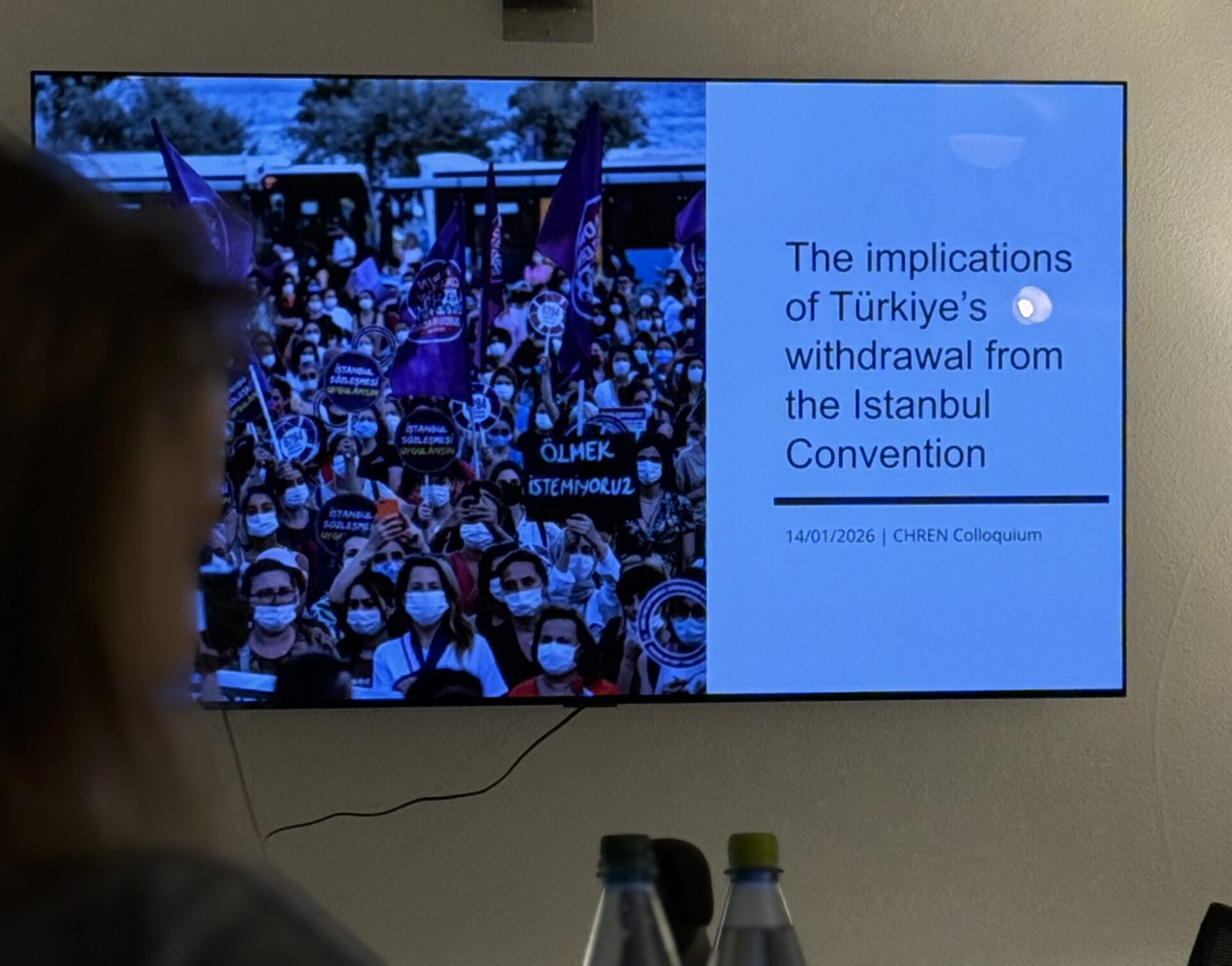
On 14 January
The presentation prompted an interdisciplinary discussion on President Erdogan’s motivation for and strategy behind his withdrawal as well as an exchange on the nexus between autocratization and gender ideology narratives. By trading protections against gender-based violence for conservative political capital, the Turkish leadership reinforces a “strongman” narrative, positioning the patriarch – rather than international law – as the ultimate protector; a theme frequently observed within backsliding democracies and autocratic regimes. Even though Türkiye continued to “pay lip service” to human rights, claiming (like other actors advocating withdrawal from human rights treaties) that it had sufficient domestic legislation in place, it was pointed out that without a robust international monitoring system, domestic accountability remained a profound challenge.

Normative and Legal Erosion
Seen from this angle, the withdrawal from the Istanbul Convention might foreshadow a much wider trend. With the Osman Kavala case the session underscored a worrying erosion of the European Court of Human Rights’ (ECHR) power. Without the domestic transposition of international rules, accountability becomes increasingly elusive, leaving human rights defenders in a precarious legal void. Participants noted that Türkiye’s strategic decision to remain in the CoE while exiting specific conventions can be viewed as “window dressing”, maintaining the appearance of democratic membership to preserve international dialogue while undermining the core rules from within. Amidst these geopolitical complexities, the withdrawal constitutes a significant retreat from international commitments, illustrating how human and particularly women’s rights protections are disposable to serve as a bargaining chip for conservative political manoeuvres. Yet, on a slightly more positive note, it is likewise important to also remember that despite similar backsliding tendencies in other CoE member states, more states have joined the Istanbul Convention since Türkiye’s withdrawal than governments have considered a respective exit (e.g. Latvia).
Speaker bio
Janina Heaphy is an Assistant Professor at the FAU Center for Human Rights (CHREN), where she researches and teaches foreign policy analysis, human rights, diplomacy, and security studies. In her previous research, Janina Heaphy examined the emergence of extraterritorial human rights protections in American, British, and German counterterrorism efforts and has since researched various accountability mechanisms as well as state strategies for avoiding said accountability in light of international norm violations. She is a co-editor of the Journal of Human Rights (zfmr) and takes on senior executive responsibilities within the CHREN. In the course of her academic career, Janina Heaphy has worked as a Lecturer and (Senior) Research Associate at the universities of Leiden, Bamberg, Munich (LMU), and Aston University Birmingham.

About the FAU CHREN Human Rights Colloquium
Organized by the FAU Research Centre for Human Rights Erlangen-Nürnberg (FAU CHREN), our inter- and transdisciplinary brings together scholars and practitioners to discuss current issues in human rights research and practice.
Colloquia are organised on a rolling basis and are co-convened by Dr Janina Heaphy and Professor Eva Pils. Events are invitation-only. Enquiries should be directed to the co-conveners and/or to humanrights@fau.de.
